
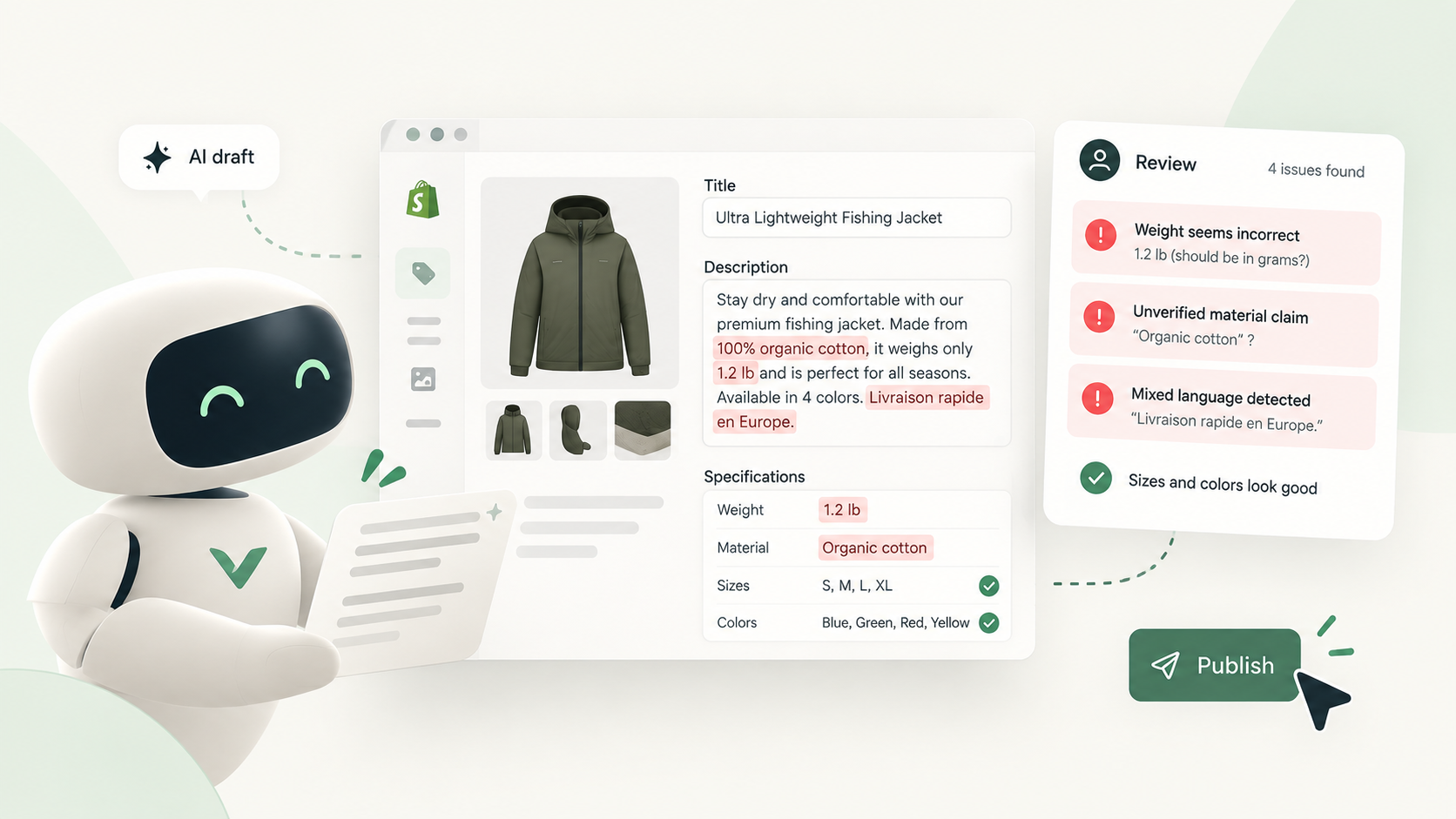
Key takeaways
- The most expensive AI errors are the plausible ones: an invented material or a wrong unit reads just as fluently as a correct one.
- Check every number, material and claim in the proposal against a source you trust, not against your memory of the product.
- Handles, variants and translations fail silently, so review them as fields, not as part of the prose.
- A field-level diff shows only what changed, which turns a full re-read into a short, targeted check.
Why AI errors survive a quick read
A human writer who does not know a fact usually leaves a gap or a question. A language model fills the gap with something that sounds right. That is the whole difficulty of reviewing AI copy: the errors are written with the same confidence and fluency as the correct sentences, so reading for flow does not surface them.
The patterns below are the ones worth checking for systematically. None of them is rare in principle, because each one follows from how models write: they predict likely text, they average what they have seen across many stores, and they do not know your product. The examples are hypothetical, built around an imaginary store, to show what each error looks like on the page.
Read a proposed description as a list of claims to verify, not as a paragraph to enjoy.
Errors of fact
1. Invented specs or materials
The model is asked to “make the description richer” and adds details it has no source for. Say a store sells a merino beanie:
- Before (your data): “100% merino wool, knitted in Portugal.”
- After (AI proposal): “100% organic merino wool, sustainably sourced and knitted in Portugal.”
“Organic” and “sustainably sourced” are claims that need evidence (a certification, a supplier statement). If you cannot point to it, remove it.
2. Wrong dimensions or units
Numbers get rounded, converted or swapped between fields. Conversions are where it goes wrong most visibly:
- Before: “Weight: 1.2 kg (2.6 lb).”
- After: “Ultra-light at just 1.2 lb.”
Check every number against your spec sheet, and check the unit next to it. Pay extra attention when the store sells in markets that use different systems.
3. Unverifiable superlatives
Models reach for “the best”, “the softest”, “the most durable” because that is what product copy often sounds like.
- Before: “Double-stitched seams on the shoulders and pockets.”
- After: “The most durable jacket on the market.”
The first sentence is a fact a customer can check. The second is a claim nobody can support. Replace superlatives with the concrete detail that made you want to write them.
4. Health, safety or legal claims
This is the pattern with the highest stakes. A model can turn a neutral description into a medical or safety promise in one adjective:
- Before: “Cotton-bamboo blend, soft against the skin.”
- After: “Hypoallergenic and antibacterial, ideal for eczema-prone skin.”
In many markets, claims about health, safety, certifications or regulatory compliance are regulated and may need proof. A reviewer should treat any such claim as blocked until someone confirms it is true and allowed.
Errors of consistency
5. Contradictions with variants or other fields
The description is written in isolation, so it can disagree with the rest of the product: variant options, tags, metafields, the SEO description.
- Variants: S, M, L in navy and grey.
- AI description: “Available in five colours, from XS to XXL.”
The same applies to care instructions in a metafield that contradict the body text, or an SEO meta description that mentions a feature the product does not have. Read the description against the variant list, not only on its own.
6. Changed handles and broken links
If a proposal touches the URL handle, the product’s address changes. A model asked to “optimise SEO” may rewrite merino-beanie as best-organic-merino-wool-beanie-hat. Unless a redirect exists from the old URL, links from ads, emails and other sites stop working. Links inside the description can also be rewritten to pages that do not exist.
Rule of thumb: a handle change should be deliberate and rare, never a side effect of a copy refresh.
Errors of quality
7. Generic filler shared with competitors
- After: “Elevate your everyday style with this versatile piece, crafted for comfort and designed to last.”
That sentence could sit on thousands of product pages. It is not false, which is why it gets through review, but it tells the customer nothing and gives search engines no reason to prefer your page. Google’s guidance on helpful content asks whether a page provides original information and substantial value; filler does neither. Ask the author to replace each generic line with a fact: fabric weight, fit notes, what customers ask support.
8. Keyword stuffing
- After: “This merino beanie is the perfect merino wool beanie for anyone looking for a warm merino beanie hat for winter.”
Google’s spam policies name keyword stuffing explicitly: filling a page with keywords in an attempt to manipulate rankings. Repetition also reads badly to customers. One natural mention of the main phrase in the title, one in the description and one in the SEO fields is usually enough.
9. Wrong language or mixed locales in translations
When AI translates, it can leave a sentence in the source language, mix regional variants, or translate things that should stay as they are.
- French proposal: “Bonnet en laine mérinos. Machine washable at 30 °C.”
- Spanish proposal: a translated brand name, or a product name in the source language while the rest is translated.
Check each locale on its own, with someone who reads the language, and watch for untranslated fragments, invented product names and units that did not follow the market.
A 9-point checklist for every proposal
Run it on the proposed version before approving. Anything that fails goes back to the author with a note saying which line and why.
- Every material and origin claim has a source
- Every number and unit matches the spec sheet
- No superlative without evidence
- No health, safety or legal claim unconfirmed
- Description agrees with variants, tags and metafields
- Handle unchanged, or changed on purpose with a redirect
- No sentence a competitor could publish verbatim
- Main keyword used naturally, not repeated
- Each translation fully in the right language
How a field-level diff speeds this review
Most of the time spent reviewing AI copy goes into finding what changed. If a proposal arrives as a new block of text, the reviewer has to re-read everything and compare it with the live page from memory. That is exactly the condition under which a swapped unit or an added “hypoallergenic” slips through.
A field-level diff reverses the work. You see the live and proposed versions side by side, field by field (title, handle, description, SEO title and meta description, tags, metafields), with added and removed words highlighted. The checklist becomes targeted: an added adjective jumps out for points 3 and 4, a changed number for point 2, any change in the handle field for point 6. Unchanged fields need no attention at all.
This is how review works in Vetta. Versions proposed by a person, a CSV import or an AI agent wait in a queue, and a reviewer sees a word-by-word diff of each field, in the source language and in each published translation, with one tab per locale for pattern 9. The reviewer approves, requests changes with a note, or rejects. Nothing reaches the storefront until someone approves it, and if a problem is found later, the version history lets you restore the previous text as a new version.
The AI can keep drafting. The review is where you decide what your store actually says.
Sources and references
- Spam policies for Google web searchGoogle Search Central · documentation
- Creating helpful, reliable, people-first contentGoogle Search Central · documentation

Hugo built his first Shopify stores around 2015, while studying management and accounting, after teaching himself to code as a teenager. He then specialised in digital marketing at ESCEN in Bordeaux and has worked with clients since 2018, first in web communication, then as a webmaster. Since 2020 he has led IT projects at Rodhouse, including its full migration to Shopify in 2023, and is now its Tech Lead. Vetta grew out of a problem he kept meeting with clients: content changed by people nobody had checked, with no way back. Away from the screen, he travels, keeps a close eye on investing and new technology, and spends as much time as he can on the water.
Frequently asked questions
Can I publish AI-generated product descriptions on Shopify without review?
Technically yes, nothing stops you. The risk is that an invented spec, a wrong size or an unsupported health claim goes live and reaches customers, marketplaces and search results. A human check against your product data before publishing is the cheapest way to avoid that.
Does Google penalise AI-written product descriptions?
Not for being AI-written. Google's guidance judges content on its quality and usefulness, not on how it was produced. What its spam policies do target is content made mainly to manipulate rankings, such as keyword stuffing, whatever tool wrote it.
What should a reviewer check first in an AI product description?
Facts before style: materials, dimensions, units, compatibility and any claim about health, safety or certification. Tone and wording matter, but a wrong fact is the error that causes returns and complaints.